

approx. 4 min. reading time

Shift-Left Quality Engineering: Quality Starts Before the Merge
Written by Swetha Polepalle /
November 2026

Table of Contents:

Shift-Left Quality Engineering: Quality Starts Before the Merge
A green pipeline only helps if the team trusts it. That is what shift-left quality engineering is about. Early tests give quick feedback, but only as long as the tests themselves are reliable and looked after.
When it comes to software for medical devices, early feedback is of particular importance. This is evident from our experience of working on projects in the life sciences sector at TestSolutions. A defect can result in additional testing efforts and a delayed release. Depending on the nature of the problem, it can also pose a risk to patients. Problems found early are usually easier to track down. However, early testing doesn’t replace technical assessment or later verification though.
What Shift-Left Means in a CI/CD Pipeline?
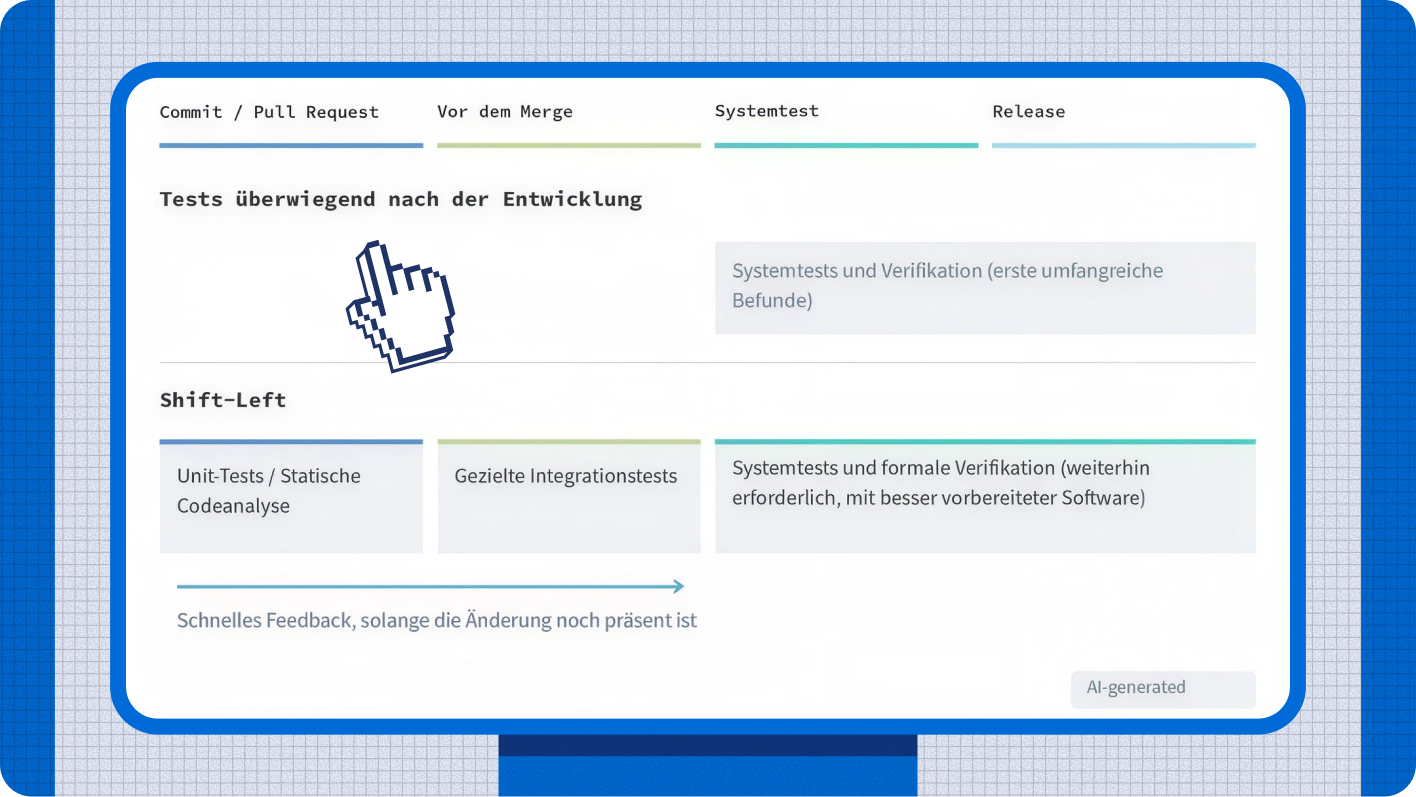
Software used to be tested thoroughly only once development was finished. By the time a defect turned up, the team had often moved on to something else. Shift left brings suitable checks into everyday development and into the CI/CD pipeline, the automated process that integrates, checks and delivers code.
A typical setup looks like this:
- Commit or pull request: Fast unit tests and static code analysis run. They check individual functions and flag risky coding patterns, such as unused variables, unhandled exceptions or possible null-pointer errors.
- Before the merge: Targeted integration tests run when a change affects how components or interfaces work together.
- When a check fails: The team gets feedback straight away. Someone looks into the finding and fixes the cause before the change is merged.
- Later stages: Broader system tests and formal verification follow at the appropriate points in development and release.
When selecting tools, teams working on regulated projects should take applicable quality requirements into account and document their decisions as necessary. For example, teams can use pytest or JUnit for unit tests and SonarQube for static analysis. However, tools alone do not constitute a strategy. It is also important to clarify which checks are required for each change and who will investigate the issue if a test fails.
Why Early Tests Matter in Regulated Projects
In medical device software, a defect may need a documented assessment, traceability and proof that it has been fixed. How much depends on how serious the finding is and on the quality processes that apply. Catching defects early can reduce rework and help teams resolve problems before they reach later testing and approval.
Automated checks are good at spotting simple logic errors and integration problems early. They can’t replace targeted testing and human judgement when it comes to technical risks, unexpected system behaviour or whether the requirements are really met. The goal isn’t to skip later verification. It is to go into it with better-prepared software.
Why a Test Suite Is Only as Good as Its Maintenance
It is easy to forget that a test suite is never finished. Tests have to evolve with the application. When a feature changes, a test can go out of date. A UI test can fail because of a timing issue even though the product works fine. Tests that sometimes pass and sometimes fail with no relevant change are called flaky tests.
False alarms are more than annoying. If the pipeline keeps turning red without a real defect, people stop taking it seriously. The team then has to work out whether the code or the test is to blame, and real problems can slip through.
So maintenance is part of test automation. That means investigating failures, stabilising flaky tests, and updating or deleting outdated ones. Developers and quality engineers decide together which checks are needed and how to handle failures. That is how early feedback stays both fast and credible.
The Takeaway: Start with Fast, Reliable Checks
Shift-Left Quality Engineering is not an additional testing phase, nor does it guarantee the early detection of every defect. Rather, it is a way of working that integrates quality into development by performing meaningful tests early on, taking the results seriously and maintaining the test suite. At TestSolutions, we believe that quality is a shared responsibility between the development and quality engineering teams.
To get started, add quick tests for common and relevant defects at the point where the code is merged. Decide who will investigate failures and deal with flaky tests consistently. Gradually you’ll end up with a pipeline whose feedback the team can trust.

Ready for quality checks before the merge?
Would you like to implement or improve shift-left testing in your regulated software projects? TestSolutions supports you every step of the way, from test strategy to implementation. Contact us.